Catalogue
Looks
The twenty-three looks a film can have, from flat to WebGL fields, a picture of your own as the backdrop, and whole palettes made from one colour.
Twenty-three presets, one line in a page: FX.look({ preset: 'mesh', palette: C }), or #look=mesh in the URL to try one without editing. A look is a backdrop (flat, gradient, field or picture), soft brand light, dots, grid or lines in parallax, a floor in perspective or a spotlight, a finish (vignette, grain) and the effects that lean on it: frosted glass, click ripples, focus-pull headlines.
The presets are plain, paper, dots, grid, aura, spotlight, mesh, silk, sunrise, halo, night, studio, meshdark, lava, aurora, caustics, topo, halftone, clouds, lines, dunes, floor and ember. Of these, caustics, topo, halftone and clouds are WebGL fields.
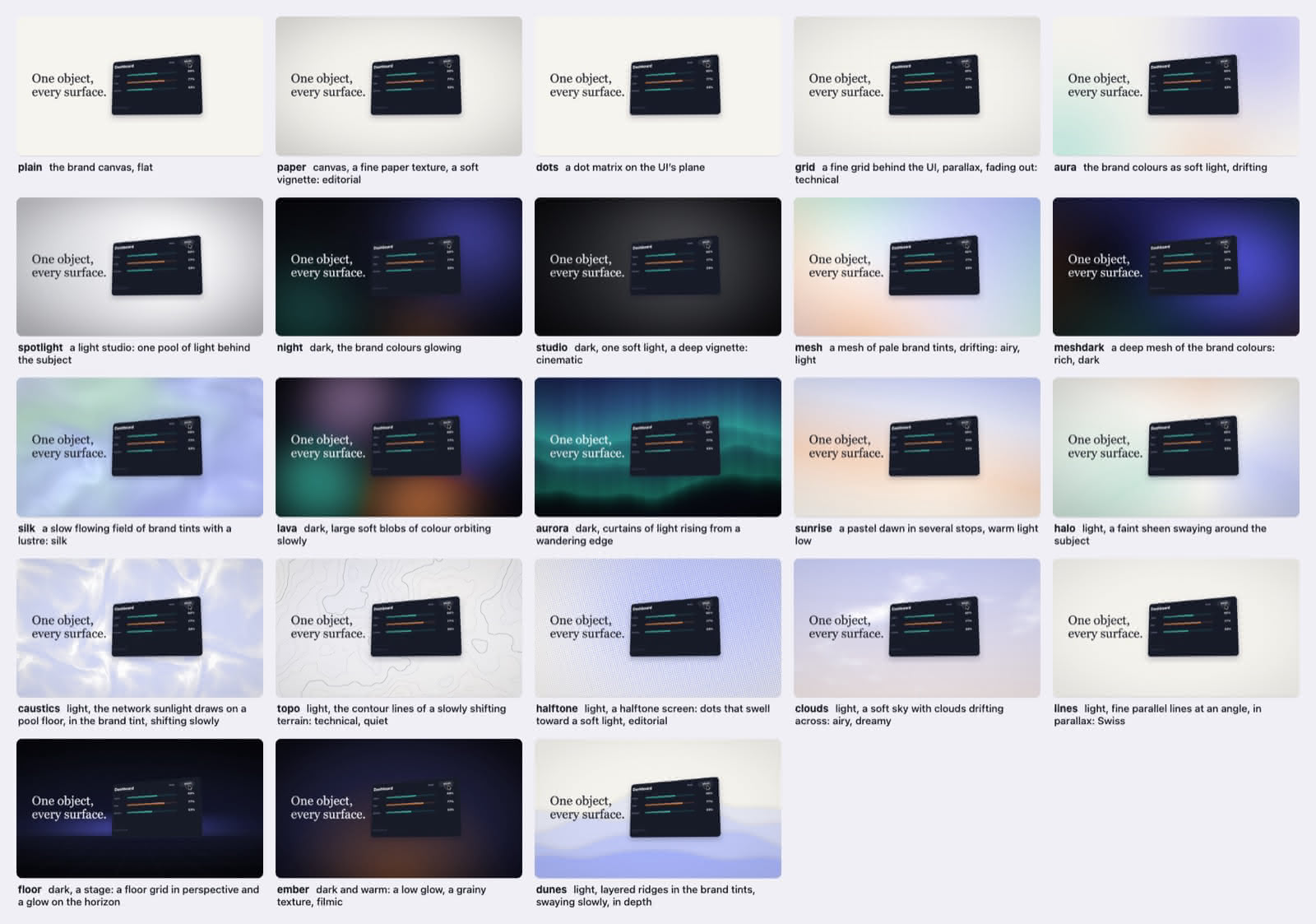
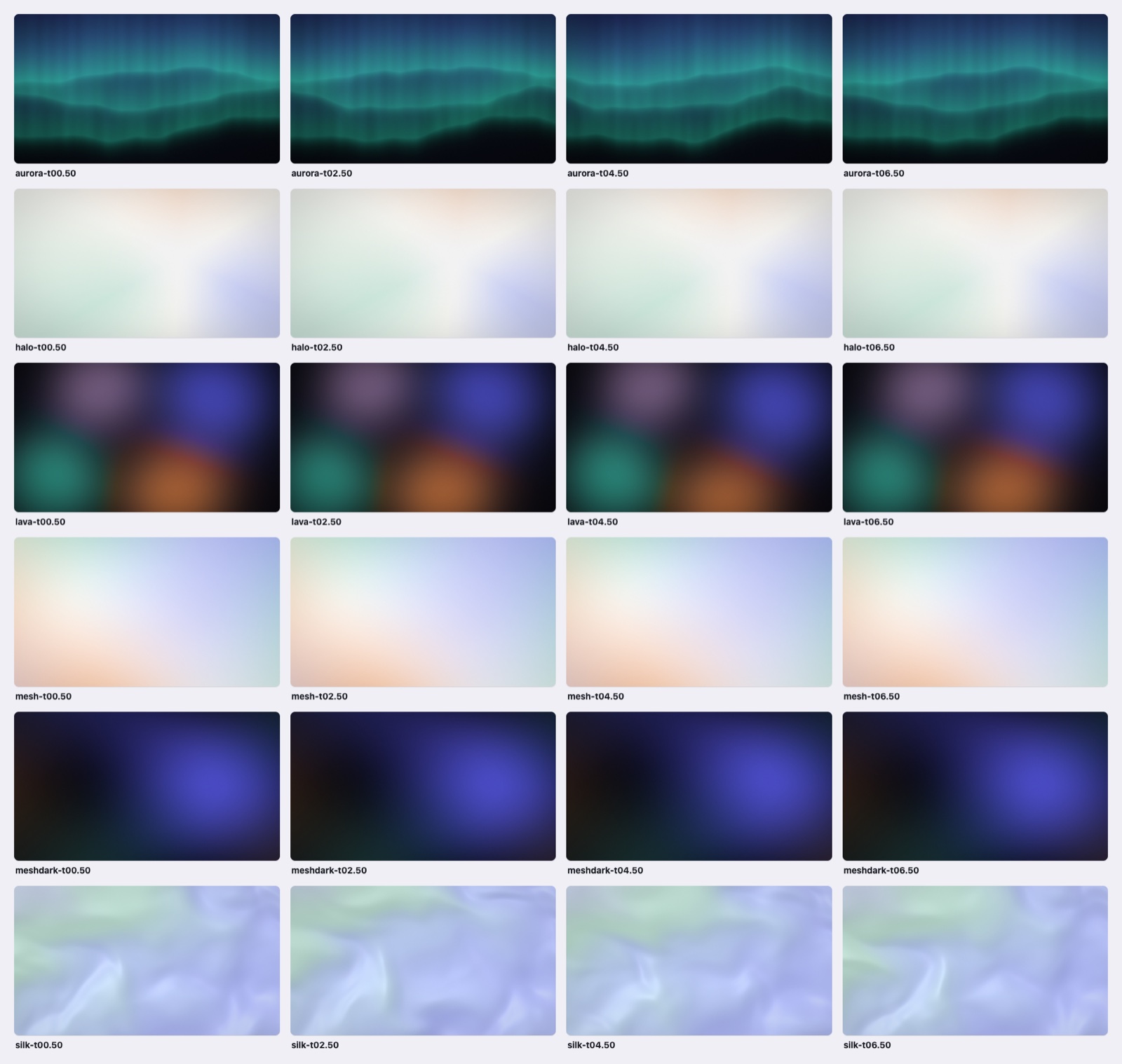
node render.mjs looks looks 4.5 makes this sheet for any film.The fields move, slowly, a whole number of cycles per film, so a loop still closes and a five-minute film moves no faster than an eight-second one:
A picture of your own
A picture can be the backdrop, cover-fit and baked once:
FX.look({ preset: 'photo', palette: C,
  base: { image: 'backdrops/x.jpg', blur: 10, duotone: ['deep', 'pale'], drift: 0.04 } })
tint lays the brand over it instead, dim darkens it for light text, and drift is a slow Ken Burns that still closes the loop. In the Studio these are the blur, the treatment (dimmed, brand tint, duotone) and the drift. The brief records where the picture came from, and Claude asks before a film with a picture that is not your own photo goes out.
Palettes and chapters
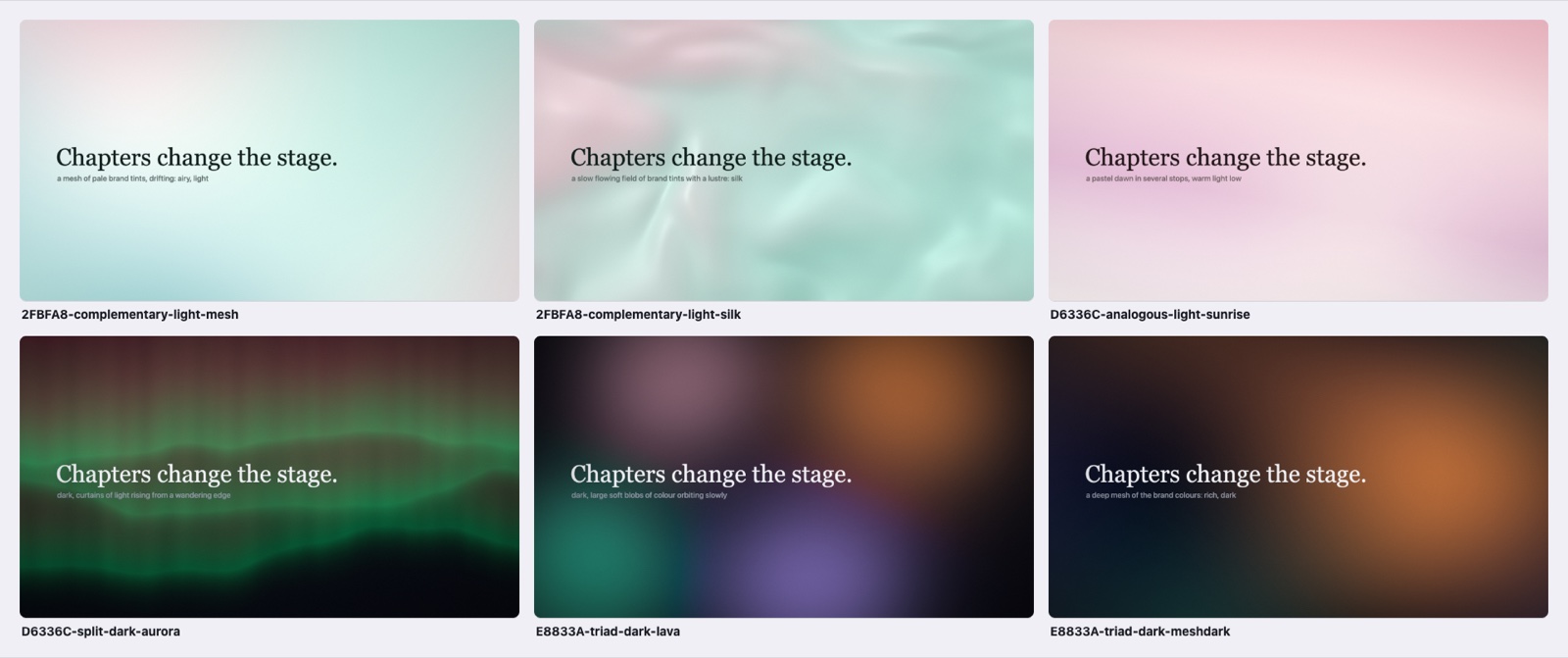
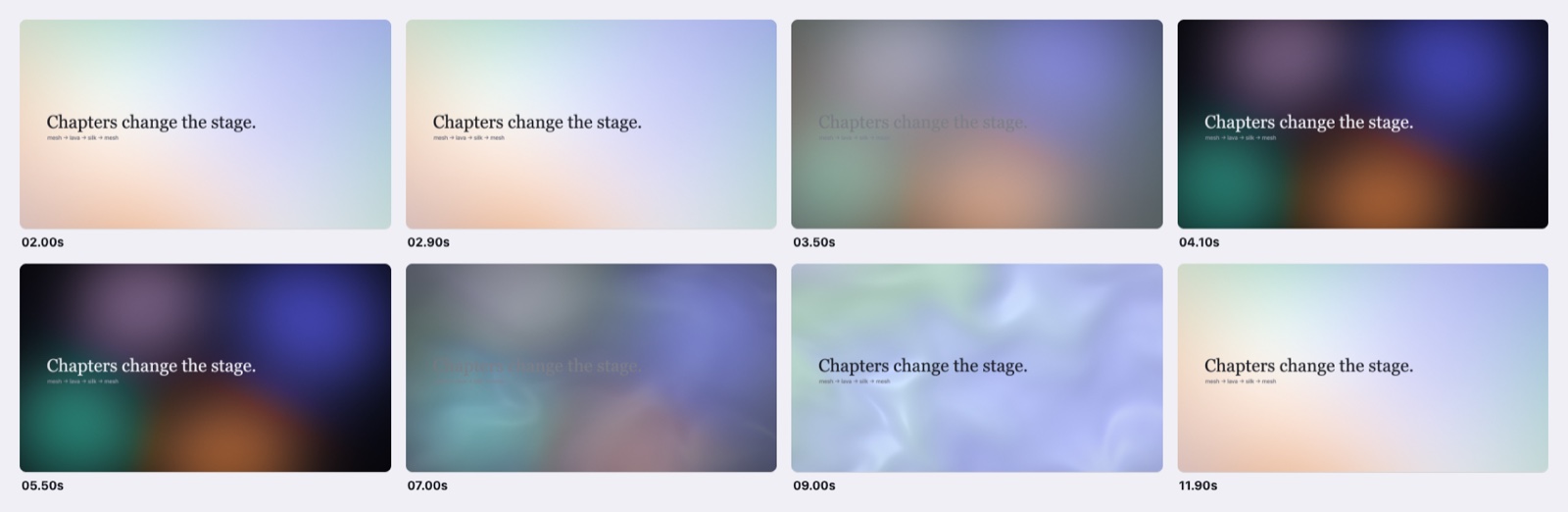
A whole palette from one colour: FX.palette('#2FBFA8', { scheme: 'complementary', tone: 'light' }). The schemes are analogous, complementary, triad, split and mono. A stage can change by chapter: FX.sequence([[0, a], [24, b], …], { fade: 0.8 }).
Choosing: ask for the looks sheet on the film’s first real frame, and pick by eye. See Making a film.