Catalogue
Formats
The eleven formats a film can take, the first decision of a film and the one to vary, each with what it fits.
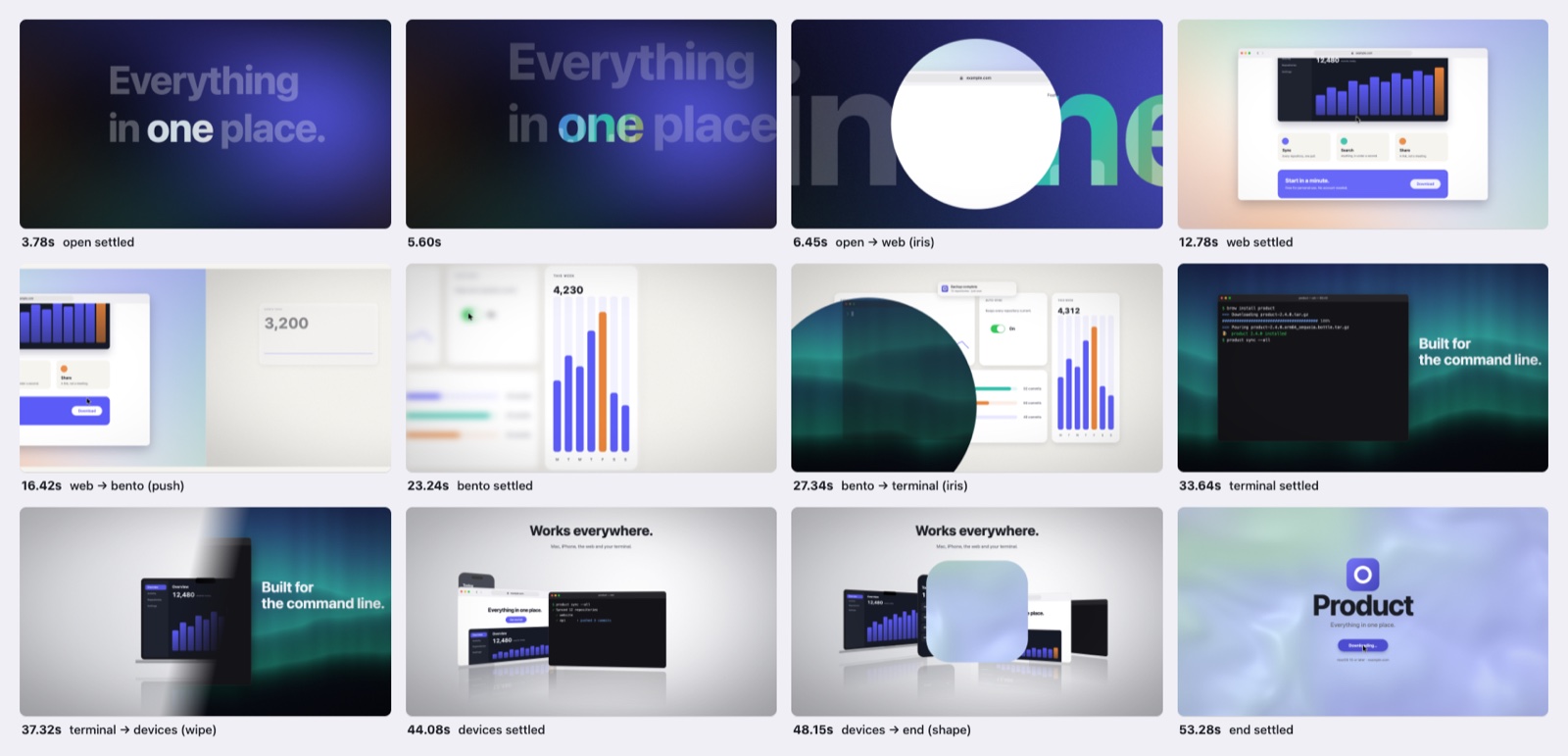
The first decision of a film, and the one to vary: three storyboards are three formats, not three pacings of one idea. reel.html runs six of them on a timeline, with the stills render.mjs sheet takes at every scene settled and every transition half done:
| Format | Fits |
|---|---|
| One-object morph | an app with a strong shape language |
| Kinetic type | a launch, a teaser, a manifesto |
| Browser walkthrough | a web product, a site |
| Bento | a product with many small features |
| Terminal | a CLI, a developer tool |
| Devices in 3D | cross-platform, “works everywhere” |
| Zoom-through | a story of depth: each scene inside a detail of the last |
| Data story | monitoring, analytics, a quota |
| Before / after | a speed-up, a redesign |
| Tutorial | onboarding, a long film |
| What’s new | a release (release films) |
In the Studio, pick up to three, or leave it to Claude, which chooses three different ones for the product and unlike its previous films. Hovering a format plays its scenes in your colour and look.
Two templates ship with the engine: promo.html, a loop with one object travelling through the product’s surfaces, a real cursor and 3D in WebGL, and reel.html, a long film on a timeline with six scenes, six formats, five transitions and a look per chapter. A timeline of scenes carries a film of any length, and chapters land in the mp4 and in a list for a YouTube description.